BSS138
Multiple (onsemi, Nexperia, Diodes Inc, Vishay) · MOSFETs · SOT-23 (3-lead) · SMD
Profile bss138 Profiled: 30 Aug 2026
Lifecycle: Active
Availability risk: Low
Specification
Transcribed from the manufacturer datasheet
| Type | N-channel enhancement MOSFET, logic level |
|---|---|
| Vds | 50 V |
| Id | 200 mA continuous at 25 °C |
| Rds(on) | 3.5 Ω at Vgs = 10 V, 6 Ω at Vgs = 4.5 V |
| Vgs(th) | 0.8 V to 1.5 V |
| Gate charge | ~1.5 nC total |
| Power | 300 mW at 25 °C |
| Tolerance | Rds(on) ±20 % lot spread |
| Voltage rating | 50 V Vds, ±20 V Vgs |
| Lifecycle | Active |
| Datasheet reference | onsemi BSS138 datasheet, rev. 2023-05, figs. 1-3 and the transfer characteristic showing the threshold spread band |
|---|---|
| Manufacturer | Multiple (onsemi, Nexperia, Diodes Inc, Vishay) |
| Mounting | SMD |
Substitute graph
3 Alternates
Interchangeable part numbers for this profile. A solid node is already profiled in this catalogue; a hollow node is a valid substitute that has no profile yet.
-
2N7002 profiled
The other classic level-shifter FET: 60 V, 300 mA, but 1.2 V to 2.5 V threshold, which makes it unreliable at 1.8 V logic. BSS138 with its 0.8 V minimum threshold is the safer choice below 2.5 V.
-
BSS138LT1G not yet profiled
onsemi's version of the same part number. Fully interchangeable; onsemi publishes a slightly different Rds(on) at 2.5 V. When second-sourcing across manufacturers, verify the threshold voltage range rather than the Rds(on).
-
BSS138DW-7 not yet profiled
Dual BSS138 in a SOT-363 (6-lead) package. Two level shifters in the footprint of one SOT-23 plus a bit — ideal for a bidirectional I2C translator, which needs exactly two of these.
Selection notes
The only prose on this page
The bidirectional level shifter, and what limits it
Gate to the low-side rail, source to the low-side signal, drain to the high-side signal, plus a 10 kΩ pull-up on each side: that is a working 3.3 V to 5 V I2C translator. The limit is speed. With 10 kΩ pull-ups and roughly 20 pF of bus capacitance, the rising edge has a 200 ns time constant, which makes 400 kHz I2C comfortable and 1 MHz not. Reducing the pull-ups to 2.2 kΩ speeds it up and increases the static current in the low state.
6 Ω on-resistance is fine here
For a level shifter the current is microamps, so 6 Ω of channel resistance is irrelevant — the signal is limited by the pull-ups, not the FET. This is why BSS138's poor Rds(on) does not matter in its most common application, and why substituting a lower-resistance part does not improve the circuit.
Not a power switch
200 mA at 3.5 Ω is 0.14 W in a SOT-23 with about 350 °C/W thermal resistance, a 50 °C rise. The part is rated 300 mW at 25 °C, so 200 mA is genuinely the ceiling and only with a good pad. For anything above 100 mA continuous, use AO3400A or a similar low-Rds(on) part instead of pushing BSS138.
Sources
Vishay Siliconix — https://www.vishay.com/docs/62253/sq9945cey.pdf · Texas Instruments — https://www.ti.com/lit/an/slva840/slva840.pdf · NIST — https://www.nist.gov/standardsgov/compliance-faqs-rohs
| Sourcing — Availability risk | BSS138 is multi-sourced by at least five major manufacturers plus numerous Asian suppliers, and the price is a few cents. There is no meaningful supply risk in this part number, which is one reason it has become the default hobby and industrial level shifter. |
|---|---|
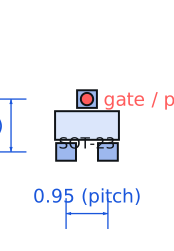
| Pinout and handling | Standard SOT-23 MOSFET pinout: pin 1 gate, pin 2 source, pin 3 drain, with the single-lead side being the gate. The intrinsic body diode points from source to drain, and in a bidirectional level shifter that diode is not parasitic — it is the mechanism that pulls the low side down when the high side is driven low. |
Engineering information only. Verify every substitution against the manufacturer datasheet and your own operating conditions before committing a design. No pricing or vendor links appear on this page.