2N7002
Multiple (onsemi, Nexperia, Diodes Inc, Vishay) · MOSFETs · SOT-23 (3-lead) · SMD
Profile 2n7002 Profiled: 21 Sep 2026
Lifecycle: Active
Availability risk: Low
Specification
Transcribed from the manufacturer datasheet
| Type | N-channel enhancement MOSFET, small signal |
|---|---|
| Vds | 60 V |
| Id | 300 mA continuous at 25 °C |
| Rds(on) | 1.2 Ω at Vgs = 10 V, 1.9 Ω at Vgs = 5 V |
| Vgs(th) | 1.0 V to 2.5 V |
| Gate charge | ~1.0 nC total |
| Power | 200 mW at 25 °C |
| Tolerance | Rds(on) ±20 % lot spread |
| Voltage rating | 60 V Vds, ±20 V Vgs |
| Lifecycle | Active |
| Datasheet reference | onsemi 2N7002 datasheet, rev. 2023-01, fig. 2 transfer characteristics showing the threshold spread band and the capacitance curves |
|---|---|
| Manufacturer | Multiple (onsemi, Nexperia, Diodes Inc, Vishay) |
| Mounting | SMD |
Substitute graph
3 Alternates
Interchangeable part numbers for this profile. A solid node is already profiled in this catalogue; a hollow node is a valid substitute that has no profile yet.
-
BSS138 profiled
Same footprint and role, 50 V instead of 60 V, but a 0.8 V minimum threshold instead of 1.0 V. Below 2.5 V logic the BSS138 is the safer part; at 5 V they are interchangeable.
-
2N7002K not yet profiled
A different die with an integrated gate-source ESD protection diode and a 2.0 V maximum threshold. Better ESD robustness, tighter threshold, slightly higher price. Worth it on a connector-exposed gate node.
-
MMBF170 not yet profiled
onsemi 60 V 500 mA small-signal MOSFET with 5 Ω at 10 V. Higher current, higher resistance, and the classic part in older designs where a 2N7002 has since been substituted in.
Selection notes
The only prose on this page
The threshold spread is the real specification
Vgs(th) spans 1.0 V to 2.5 V, a 1.5 V window. At a 3.3 V drive the worst-case unit has only 0.8 V of overdrive and its Rds(on) may be 5-10x the typical value; the best-case unit is fully on. For a LED or relay driver that inconsistency is harmless. For anything where the current must be predictable, use a part with a tighter threshold or drive the gate to 10 V.
ESD sensitivity
The standard 2N7002 has a thin gate oxide and no integrated protection; the gate is rated ±20 V DC but only a few tens of volts of ESD transient. Any gate node that reaches a connector should have either a series resistor and a clamp or the protected 2N7002K variant. Handling damage on this part often shows up as a gate that leaks at a few microamps, which is enough to keep the device partially on.
Where 60 V and 300 mA are enough
The combination of a 60 V rating with a tiny SOT-23 body makes it the default for driving relays, buzzers, small solenoids and LED strings up to about 100 mA, and as the pass element in low-current level shifters. Above 100 mA continuous it loses to BSS138 in cost-performance only marginally and to AO3400A decisively.
Sources
Vishay Siliconix — https://www.vishay.com/docs/62253/sq9945cey.pdf · Texas Instruments — https://www.ti.com/lit/an/slva840/slva840.pdf · NIST — https://www.nist.gov/standardsgov/compliance-faqs-rohs
| Sourcing — Availability risk | The 2N7002 is one of the most widely second-sourced transistors in existence, with compatible parts from at least eight manufacturers and prices under two cents at volume. Supply risk is negligible. |
|---|---|
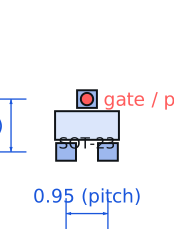
| Pinout and handling | SOT-23 with pin 1 gate, pin 2 source, pin 3 drain, the same arrangement as BSS138 and AO3400A. The threshold range of 1.0 V to 2.5 V means that at a 3.3 V drive some units are fully enhanced and some are only partially on — a spread that shows up as inconsistent behaviour between boards. |
Engineering information only. Verify every substitution against the manufacturer datasheet and your own operating conditions before committing a design. No pricing or vendor links appear on this page.