MBR0520LT1G
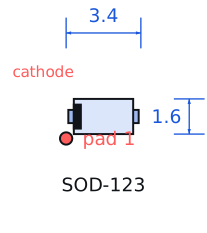
onsemi · Diodes · SOD-123 · SMD
Profile mbr0520lt1g Profiled: 27 Oct 2026
Lifecycle: Active
Availability risk: Low
Specification
Transcribed from the manufacturer datasheet
| Type | Schottky barrier rectifier, low Vf |
|---|---|
| Forward current | 500 mA continuous at 90 °C |
| Reverse voltage | 20 V |
| Forward drop | 0.25 V typical at 10 mA, 0.385 V max at 500 mA |
| Reverse recovery | No reverse recovery |
| Capacitance | 60 pF typical at 0 V |
| Tolerance | Not applicable (Schottky grade) |
| Voltage rating | 20 V reverse |
| Lifecycle | Active |
| Datasheet reference | onsemi MBR0520L datasheet, rev. 2022-07, fig. 2 forward voltage vs instantaneous current and the thermal resistance table |
|---|---|
| Manufacturer | onsemi |
| Mounting | SMD |
Substitute graph
3 Alternates
Interchangeable part numbers for this profile. A solid node is already profiled in this catalogue; a hollow node is a valid substitute that has no profile yet.
-
MBR0520LT3G not yet profiled
Identical device on a 13-inch reel rather than 7-inch. Purely a packaging difference; useful when your feeder is tooled for the larger reel and the line refuses the smaller one.
-
PMEG2010AEH not yet profiled
Nexperia 20 V 1 A Schottky with 0.34 V at 1 A and lower capacitance. Higher current in the same SOD-123 style body; check the thermal pad requirement since it is a different land pattern.
-
BAT54S profiled
Not a substitute — 30 V but only 200 mA and a series pair topology. Listed here because the SOD-123 and SOT-23 outlines are sometimes confused on dense boards, and the resulting 200 mA limit is a real failure mode.
Selection notes
The only prose on this page
0.25 V at 10 mA is the reason to pick it
In a battery-powered design the diode drop is often the single largest fixed loss. At 10 mA this part drops 0.25 V where a 1N4148 drops 0.72 V, which is 4.7 mW saved per diode. On a 3.7 V lithium cell feeding a 3.3 V rail, that difference is the gap between 89 % and 93 % efficiency at low load.
20 V is a hard ceiling on a 12 V rail
A 20 V Schottky on a 12 V rail has 8 V of margin, which is enough for a clean supply but not for one that rings. A 12 V rail with a 5 V inductive kick from a relay coil will exceed 20 V and destroy the diode. Use a 30 V or 40 V part anywhere the rail can see inductive transients, even if the steady-state voltage is 5 V.
Thermal reality of 500 mA in SOD-123
The 500 mA rating is at 90 °C, which implies roughly 0.2 W dissipation and a case rise the SOD-123 can only just handle with a decent copper pad. onsemi specifies about 220 °C/W junction-to-ambient on a minimal footprint, so 0.2 W is a 44 °C rise. If the diode is doing continuous 500 mA, give it 50 mm² of copper or move to an SMB part.
Sources
Vishay Semiconductors — https://www.vishay.com/docs/81857/1n4148.pdf · Texas Instruments — https://www.ti.com/lit/an/slva840/slva840.pdf · NIST — https://www.nist.gov/standardsgov/compliance-faqs-rohs
| Sourcing — Availability risk | 20 V 500 mA Schottky in SOD-123 is made by onsemi, Vishay, Nexperia and several Asian suppliers. Because 20 V is a low rating, this part is used almost exclusively on 5 V and 3.3 V rails, which limits demand spikes. Stock is reliable. |
|---|---|
| Pinout and handling | Polarised: banded end is the cathode. In an ORing configuration the two anodes face the sources and the cathodes join at the output; putting one in backwards means that source is shorted to the output whenever the other source is live. |
Engineering information only. Verify every substitution against the manufacturer datasheet and your own operating conditions before committing a design. No pricing or vendor links appear on this page.