IRF9540N
Infineon (formerly International Rectifier) · MOSFETs · TO-220AB · Through-hole
Profile irf9540n Profiled: 18 Oct 2026
Lifecycle: Active
Availability risk: Low
Specification
Transcribed from the manufacturer datasheet
| Type | P-channel enhancement MOSFET |
|---|---|
| Vds | -100 V |
| Id | -23 A continuous at 25 °C |
| Rds(on) | 117 mΩ at Vgs = -10 V |
| Vgs(th) | -2.0 V to -4.0 V |
| Gate charge | 97 nC total at Vgs = -10 V |
| Power | 150 W at 25 °C case |
| Tolerance | Rds(on) ±10 % typical lot spread |
| Voltage rating | -100 V Vds, ±20 V Vgs |
| Lifecycle | Active |
| Datasheet reference | Infineon IRF9540N datasheet, rev. 2022-11, figs. 1-3 and the SOA chart for the P-channel die |
|---|---|
| Manufacturer | Infineon (formerly International Rectifier) |
| Mounting | Through-hole |
Substitute graph
3 Alternates
Interchangeable part numbers for this profile. A solid node is already profiled in this catalogue; a hollow node is a valid substitute that has no profile yet.
-
IRF4905 not yet profiled
Same -100 V P-channel family with 20 mΩ at -10 V instead of 117 mΩ. Five times the conduction performance and roughly 3x the price; the gate charge rises to 180 nC, so the drive requirement doubles.
-
IRF9540NPBF not yet profiled
The lead-free version of the same device, which is now the only one shipping. Listed here because older schematics reference the non-PBF part number and buyers sometimes chase the obsolete code.
-
FQP47P06 not yet profiled
onsemi -60 V 47 A P-channel with 26 mΩ at -10 V. Far better conduction but a lower voltage ceiling; use it on 24 V or 36 V rails and keep the IRF9540N for 48 V and above.
Selection notes
The only prose on this page
117 mΩ is the tax you pay for high-side simplicity
A P-channel high-side switch needs no charge pump and no bootstrap, which is why it survives in designs where the load current is modest. At 5 A the 117 mΩ channel dissipates 2.9 W, which needs a heatsink. A comparable N-channel high-side switch with a charge pump would dissipate 0.5 W at the same current. Below about 3 A the P-channel wins on simplicity; above 5 A the N-channel plus driver wins on heat.
Threshold voltage and gate drive range
Vgs(th) is -2 V to -4 V, so a 5 V logic drive barely turns the device on: at -5 V the Rds(on) is typically 200-250 mΩ, twice the datasheet figure. This part wants a 10 V gate swing. If you must drive it from 5 V, either accept the extra heat or add a small NPN level shifter that swings the gate to the full rail.
The body diode conducts in the wrong direction for you
In a P-channel device the intrinsic diode points from drain to source, which for a high-side switch means it clamps the output to the input rail. That is useful for inductive loads — it freewheels automatically — but it also means the switch cannot isolate a load from a reverse-polarity input. If reverse protection is needed, put a series diode or a dedicated ideal-diode controller ahead of it.
Sources
Vishay Siliconix — https://www.vishay.com/docs/62253/sq9945cey.pdf · NIST — https://www.nist.gov/standardsgov/compliance-faqs-rohs
| Sourcing — Availability risk | Standard P-channel TO-220 power MOSFETs are widely available from multiple manufacturers, and the IRF9540N is one of the most common. As with all TO-220 power devices, counterfeits exist; buy through franchised distribution when the part is switching more than an amp. |
|---|---|
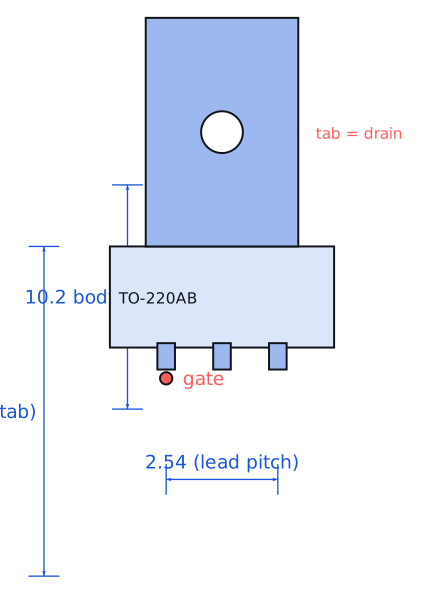
| Pinout and handling | TO-220AB with pin 1 gate, pin 2 drain, pin 3 source, and the tab tied to the drain. For a P-channel high-side switch the source goes to the positive rail and the drain to the load, so the tab sits at the positive rail — which means an uninsulated heatsink becomes a live rail at the full supply voltage. |
Engineering information only. Verify every substitution against the manufacturer datasheet and your own operating conditions before committing a design. No pricing or vendor links appear on this page.