1N4148W-7-F
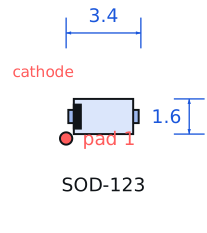
Diodes Incorporated · Diodes · SOD-123 · SMD
Profile 1n4148w-7-f Profiled: 25 Aug 2026
Lifecycle: Active
Availability risk: Low
Specification
Transcribed from the manufacturer datasheet
| Type | Small-signal switching diode, silicon |
|---|---|
| Forward current | 150 mA continuous, 300 mA surge (1 µs) |
| Reverse voltage | 100 V |
| Forward drop | 0.72 V typical at 10 mA, 1.0 V max |
| Reverse recovery | 4 ns max |
| Junction capacitance | 2 pF typical at 0 V, 1 MHz |
| Tolerance | Vf bin ±0.1 V |
| Voltage rating | 100 V reverse |
| Lifecycle | Active |
| Datasheet reference | Diodes Incorporated 1N4148W datasheet, doc DS30017, rev. 2023-04, fig. 1 forward characteristics and fig. 4 capacitance vs reverse voltage |
|---|---|
| Manufacturer | Diodes Incorporated |
| Mounting | SMD |
Substitute graph
3 Alternates
Interchangeable part numbers for this profile. A solid node is already profiled in this catalogue; a hollow node is a valid substitute that has no profile yet.
-
1N4148WS-7-F not yet profiled
SOD-323 version of the same die, roughly 60 % of the footprint. Pick it for density; the trade is that a SOD-323 pad is small enough that hand rework needs magnification and the thermal path to the board is worse.
-
MMSD4148T1G not yet profiled
onsemi SOD-123 equivalent. Same electrical behaviour; onsemi's part is specified slightly differently above 100 mA and its package drawing has a marginally wider lead, so check the land pattern if you are swapping on an existing board.
-
1N4148-TAP not yet profiled
Through-hole DO-35 version. Not a drop-in — different footprint entirely — but the correct substitute when the board is hand-wired or when you need a socket. Same 4 ns recovery, higher 500 mW dissipation.
Selection notes
The only prose on this page
The 4 ns recovery is the whole point
A 1N4148 recovers in 4 ns (per Vishay Semiconductors), which makes it usable as a clamp on signals up to about 20 MHz and as a logic steering diode without introducing visible delay. Its 1N4007 cousin recovers in 2 µs, roughly 500x slower, and using a 1N4007 as a fast clamp is a classic mistake that shows up as a distorted edge on a scope.
Clamping and the 0.72 V drop
At 10 mA the forward drop is about 0.72 V, and that is what you get in a clamp: a 3.3 V signal clamped to a 3.3 V rail with a 1N4148 can reach 4.0 V, which is enough to damage a 3.6 V absolute-maximum input. Schottky clamps at 0.35 V exist for this reason; the 1N4148 is the right part when the rail is 5 V and the protected input tolerates a 0.8 V overshoot.
Reverse leakage doubles every 10 °C
Reverse leakage at 25 °C is 1 µA at 75 V, which is negligible. At 100 °C it is around 25-50 µA. In a high-impedance node that leakage becomes a real offset: 50 µA through 100 kΩ is 5 V, which swamps any divider. Anywhere the diode sees both high impedance and high temperature, use a small-signal Schottky or reconsider the topology.
Sources
Vishay Semiconductors — https://www.vishay.com/docs/81857/1n4148.pdf · Texas Instruments — https://www.ti.com/lit/an/slva840/slva840.pdf · NIST — https://www.nist.gov/standardsgov/compliance-faqs-rohs
| Sourcing — Availability risk | The 1N4148 is the most second-sourced semiconductor in the world, with at least eight manufacturers making a compatible die. Distribution stock is measured in millions of pieces and the price is under a cent at volume. There is no realistic supply scenario where this part is unavailable. |
|---|---|
| Pinout and handling | Polarised: the cathode is marked by a band on the body. On SOD-123 the band is a printed line near one end; on the DO-35 through-hole part it is a painted ring. The band is the cathode, which is the end that connects towards the more positive node in a clamp or the supply in a flyback path. |
Engineering information only. Verify every substitution against the manufacturer datasheet and your own operating conditions before committing a design. No pricing or vendor links appear on this page.