LM358P
Texas Instruments · Logic ICs · PDIP-8, 7.62 mm row pitch · Through-hole
Profile lm358p Profiled: 29 Oct 2026
Lifecycle: Active
Availability risk: Low
Specification
Transcribed from the manufacturer datasheet
| Function | Dual operational amplifier, single-supply |
|---|---|
| Supply range | 3 V to 32 V single supply, or ±1.5 V to ±16 V split |
| Input offset voltage | 2 mV typical, 7 mV max at 25 °C |
| Input bias current | 20 nA typical, 150 nA max |
| Gain bandwidth | 1.1 MHz |
| Output swing | 0 V to Vcc - 1.5 V, sinks 20 µA minimum |
| Tolerance | Offset voltage bin ±2 mV typical; gain bandwidth ±30 % lot spread |
| Voltage rating | 3 V to 32 V supply, 32 V absolute maximum |
| Lifecycle | Active |
| Datasheet reference | Texas Instruments LM358 datasheet, doc SLOS068, rev. 2024-04, §7.5 (output swing and sink current) and §8.2 typical applications |
|---|---|
| Manufacturer | Texas Instruments |
| Mounting | Through-hole |
Substitute graph
3 Alternates
Interchangeable part numbers for this profile. A solid node is already profiled in this catalogue; a hollow node is a valid substitute that has no profile yet.
-
LM358N not yet profiled
The same part number from ST, onsemi or another second source. Electrically equivalent; the crossover distortion at the output stage differs slightly between manufacturers, which matters only in audio applications.
-
LM324N not yet profiled
Quad version of the same amplifier in DIP-14. Four channels instead of two, same electrical specification, and slightly cheaper per channel. Use it when you need three or four channels.
-
MCP6002-I/P not yet profiled
Microchip CMOS op-amp, rail-to-rail input and output, 1 MHz gain bandwidth, 1.8 V to 6 V supply. Draws 100 µA per channel instead of 500 µA and swings to within 25 mV of both rails — a large upgrade for a 3.3 V design and unusable above 6 V.
Selection notes
The only prose on this page
The output cannot reach the supply
The output swings to within about 1.5 V of the positive rail and to ground only if it is sinking at least 20 µA. On a 5 V supply the usable output range is roughly 0.02 V to 3.5 V. Any design that expects an LM358 to drive an ADC input to 4.9 V will be disappointed, and the standard fix is a pull-down resistor of 10 kΩ from the output to ground to supply the sink current.
Input range includes ground, output does not
The input common-mode range extends from ground to about Vcc - 1.5 V, which makes the part convenient for ground-referenced current sensing. Since the output range is the same, a unity-gain buffer of a 0.1 V signal works, but the same buffer of a 4.5 V signal on a 5 V rail does not.
Crossover distortion and audio use
The output stage is a Class-B totem pole, which produces a small dead zone as the output crosses zero. For DC and low-frequency instrumentation this is irrelevant. For audio it adds roughly 0.5-1 % distortion, which is audible on a quiet passage. If you need an audio amplifier at this price point, look at the TL072 or an NE5532 instead.
Sources
Texas Instruments — https://www.ti.com/lit/an/slva840/slva840.pdf · AEC — https://aecouncil.com/Documents/AEC_Q100_Rev_H_Base_Document.pdf · NIST — https://www.nist.gov/standardsgov/compliance-faqs-rohs
| Sourcing — Availability risk | The LM358 is one of the most widely manufactured analogue ICs in the world, available from TI, ST, onsemi, JRC and dozens of others at prices under ten cents. There is no supply risk, and no reason to pay a premium unless you need a specific manufacturer's offset grade. |
|---|---|
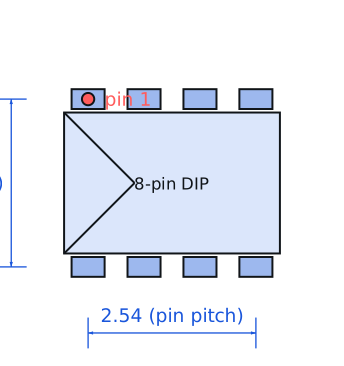
| Pinout and handling | PDIP-8: pin 1 output A, pin 2 inverting input A, pin 3 non-inverting input A, pin 4 ground, pin 5 non-inverting input B, pin 6 inverting input B, pin 7 output B, pin 8 supply. The single-supply pinout is identical to the dual-supply one, which is why the same board can often be used either way. |
Engineering information only. Verify every substitution against the manufacturer datasheet and your own operating conditions before committing a design. No pricing or vendor links appear on this page.